
Sergiy Bolotny - Little Dutch Rhapsody No.1
Sergiy Bolotny turns a one-shoed farmer into a seriously lively violin piece
My first listen to “Little Dutch Rhapsody No. 1” immediately gave me a smile, and then I start noticing just how much is happening in one violin.
The opening has that slightly cheeky folk-dance bounce, but Bolotny keeps throwing new shapes at the melody. Rapid string crossings, springy spiccato and big register jumps make the violin sound almost ridiculously busy at points, while the slower cantabile passages suddenly let everything breathe.
One minute I’m hearing this scrappy, hopping rhythmic figure, and the next, the violin is stretching into warmer and more romantic phrases. There’s also some gorgeous sliding between notes that gives the melody a slightly vocal quality.
I can hear the bow, the resonance of the room, the little shifts in attack and dynamics. It makes the performance feel close and physical. The folk tune behind it comes from Groningen and it feels playful and alive!
Interview with Sergiy Bolotny

(•)> “Little Dutch Rhapsody No. 1” begins with the humorous folk story of a farmer travelling with just one shoe. What made that particular story feel musically rich enough to inspire a concert work?
I love folk music deeply—not only from my native Ukraine, but from everywhere. Folklore is completely honest, pure, and innocent. It doesn't put on airs; it goes straight to the heart.
I have lived in the Netherlands for many years now, and this country has truly become my home. About a year ago, an idea sparked: why not explore Dutch folk traditions and bring them into my solo violin world? When I began searching, the funny tale of the farmer with one shoe was purely by accident the very first tune I found. I picked up my violin, played through the melody for a couple of minutes, started improvising, and suddenly a flood of musical ideas arrived. The piece was practically born in ten minutes. It was like love at first sight—something you feel in your bones long before you can intellectually analyze it.

(•)> You describe the Little Dutch Rhapsodies as a tribute to Dutch cultural memory while deliberately avoiding the idea of treating traditional music as a museum piece. What does it mean to you to preserve a folk tradition while fundamentally transforming it?
As a classical violinist, I learned so much from the masters about how folklore breathes life into concert music—from Haydn to Bartók and Gershwin. Folk melodies were not museum artifacts to them; they were the very foundation of their artistic voices.
To me, keeping a folk melody alive doesn't mean locking it under glass or repeating it like a museum relic. Tradition lives and breathes when you take its core spirit and let it dance in a new, modern light.

(•)> The original song has a playful, almost comic narrative, yet your version moves into progressive variation and neo-romantic violin writing. How did you translate that humour into a more sophisticated concert-music language without losing its character?
In all my compositions, I love weaving genuine folk melodies together with my own original material. I compose a little bit every single day, keeping a personal "bank" of musical sketches and themes that I can draw from.
Once a piece takes shape, it needs time to simmer. Sometimes that cooking process takes months, and sometimes it only takes a few minutes. But with this rhapsody, it felt as though someone was dictating the music directly into my ear, and my only job was to write it down as fast as I could. The humor simply carried itself through the rhythm.

(•)> The piece demands the violin's full technical and acoustic palette. Were there particular extended techniques, registers or colours that you discovered specifically while developing this rhapsody?
All of these colors and technical demands grow out of the great Romantic violin tradition—the language of Paganini, Kreisler, and Ysaÿe.
Decades of performing on stage, both as a solo recitalist and in the orchestra pit, teach you what the violin is truly capable of doing acoustically. When I write, I don’t think about technical difficulties for their own sake; I think about the singing voice of the instrument and the colors that make an audience lean forward.

(•)> Folk melodies can be powerful precisely because they are simple and memorable. How did you decide which elements of the original tune needed to remain recognisable and which could be stretched almost beyond recognition?
It is pure intuition honed by stage experience, combined with my love for concise musical miniatures.
For me, crafting a solo piece is like creating a fine chocolate bonbon: every layer must be concentrated, flavorful, and balanced, with no unnecessary filler. You keep the recognizable kernel of the melody so the listener feels grounded, but you surround it with unexpected harmonies and virtuosic textures.

(•)> You were born in Ukraine and now make your home in the Netherlands, and this piece is rooted in Dutch heritage. How has living between those cultural worlds influenced the way you approach traditional music?
Ukrainian and Dutch cultures are very different in temperament, but searching for the bridges between them is fascinating.
At the end of the day, folklore across every nation touches the same human instincts: storytelling, longing, joy, and laughter. You simply have to love the culture and love the music. Human beings are naturally wired to recognize beauty, and that beauty connects us across any border.
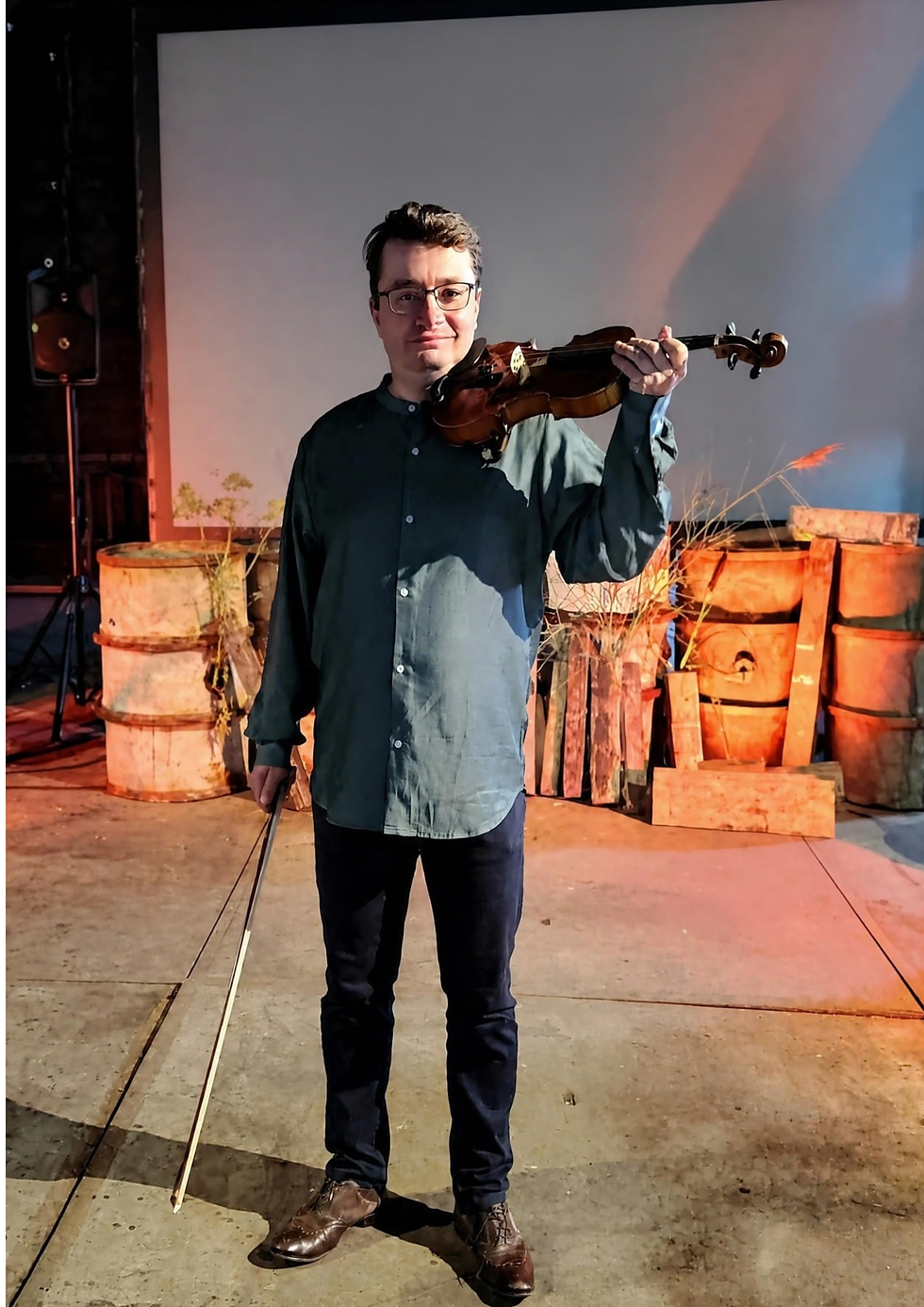
(•)> Your Ukrainian Caprices and Little Dutch Rhapsodies both transform regional musical heritage through solo violin writing. What makes the violin such an effective instrument for carrying cultural memory across borders?
The violin is simply my mother tongue. It is my heart and my direct voice.
The violin possesses an incredible universality: it can weep like a human voice, dance like a village fiddler, or soar with aristocratic elegance. Devoting your life to this instrument is completely addictive. I’ve spent my entire artistic journey searching for that distinctive, speaking voice on four strings.

(•)> As Assistant Second Concertmaster of the Noord Nederlands Orkest, you perform orchestral repertoire at the highest level while also composing your own music. Does playing the works of other composers influence the way you think about your own orchestration, even when writing for a solo instrument?
Without a doubt. Performing a Beethoven or Brahms symphony from the concertmaster chair is thrilling, but it is also an ongoing masterclass in musical architecture.
Sitting inside an eighty-piece orchestra lets you feel how great masters balance inner voices, dynamic tension, and timing. When I sit down with just a solo violin, I try to pack that entire orchestral universe—the bass line, the harmony, and the solo voice—into one single wooden box.

(•)> Your training spans Lviv, Kyiv and Vienna, three musical environments with very different traditions. How have those places shaped your understanding of what a “European” musical language can actually be?
Each city has its own distinct heritage, aesthetic philosophy, and temperament. Yet across all of them, the underlying goal remains identical: the relentless pursuit of tonal beauty, instrumental truth, and emotional depth.
Whether you are in Lviv, Vienna, Tokyo, or New York, the universal core of music never changes. True artistry always aims for that pure, unvarnished beauty of expression.
(•)> The rhythmic verve of the folk original is central to the piece. How much of the composition was driven by rhythm first, and how much came from your exploration of melody and harmony?
Rhythm was definitely the driving catalyst.
The humor and charm of the story live directly inside that rustic, stepping pulse. My initial exploration of Dutch folk music was largely motivated by an urge to experiment with unusual rhythmic meters and fresh structural ideas for the solo violin. Once the rhythmic motor started running, the melodic variations unfolded naturally on top of it.

(•)> There is a sense of movement in the idea of a rhapsody—one theme continuously transformed rather than simply repeated. Did the farmer's journey in the original story influence the structure of the musical journey as well?
Not literally. The folk song is very straightforward and playful.
My goal was first and foremost to compose a serious, standalone concert piece for the violin. Folk heritage provided the initial spark and the playful spirit, but the musical journey itself followed its own classical logic.
(•)> With both the Ukrainian Caprices and Little Dutch Rhapsodies becoming ongoing cycles, what do you hope these works ultimately contribute to the relationship between folk heritage, contemporary composition and the concert tradition?
To be completely honest, I don't compose with grand historical ambitions in mind.
I simply sit down with my violin and try to write honest, beautiful, and engaging music that speaks to people. Once it leaves my desk and enters the world, I let the music find its own path and see what happens.
(•)> That's all, Folks! Check it out on the Pigeon Opinion Playlist