
Pigeon Spins Featuring an Interview with Ralph Beeby & the Elephant Collective
- Feb 4
- 6 min read
Ralph Beeby & the Elephant Collective - Devil on my Shoulder
Could there be an alternative timeline in which the early '90s Bad Seeds covered a song by 16 Horsepower? David Eugene Edwards' fire & brimstone lyrics given a fresh, manic energy by a young Nick Cave, buoyed by Blixa Bargeld's brutalist slide guitar? If you can't imagine it, you might get close with Ralph Beeby & the Elephant Collective's new single, 'Devil on my Shoulder.'
t's a classic underdog tale of fighting for survival, for anyone who's ever had those days when it feels like the whole world is out to get you...and you might have to break a few rules to get through it.
Interview with Ralph Beeby & the Elephant Collective

(•)> The idea of an alternative timeline where the early ’90s Bad Seeds cover 16 Horsepower is striking. How consciously did those influences shape “Devil on my Shoulder”?
I certainly realised what I'd done when I got in touch with Francesca Prattica about recording drums: she asked me if there was an existing record she could use as a reference, and it dawned on me that it was a similar rhythm to 16 Horsepower's 'Black Soul Choir'! Equally, if you dig through the Bad Seeds' earlier albums, there are songs like 'Thirsty Dog' and 'Papa Won't Leave You, Henry', which have the same urgent energy behind them. I often get the urge to try and capture that kind of momentum in a song, and 'Devil on my Shoulder' is the result of exactly that - it only occurred to me while I was mixing the song that stylistically it sat somewhere between those two groups.
(•)> The song feels rooted in fire and brimstone imagery while still sounding urgent and modern. What drew you to that underdog survival narrative?
It's quite a common trope, isn't it? Everyone loves an underdog story; everyone roots for the underdog; to various extents, I dare say everyone imagines that they are the underdog from time to time! The tricky bit is getting the balance right, so it doesn't slip into cliche or caricature...if everyone's trying to play the underdog, it starts to sound like Monty Python's Four Yorkshiremen sketch.
(•)> Lyrically, the track speaks to moments when it feels like the world is stacked against you. Was there a personal experience behind that feeling?
Well fortunately, unlike the character in the song, I've never been chased through a forest by an armed posse! But there is that old saying that "bad things come in threes," and I'm sure most of us have been through a run of bad luck, where you just can't seem to catch a break. And whilst it's not about this specifically, I've noticed a regular feeling of dread when going to read the news, particularly over the couple of years - a lot of horrible people being allowed to do horrible things (because apparently, enough money basically buys you immunity from consequences), and feeling quite powerless to do much about it.
(•)> Your sound blends classic blues and rock with darker, more theatrical elements. How do you balance tradition with pushing the genre forward?
It probably helps that I'm not the only person doing this at the moment! Not the dark theatrics necessarily, but lots of Blues artists seem to be keen to fold in new elements: I hear a lot of elements of Soul and modern Rock creeping in, and bits of, shall we say, "less evil-sounding" Americana. I'm sure I'm not the only person drawing on so-called "Gothic Americana," though most of the artists within that genre tend to be more Dark-Country/Bluegrass in style...perhaps I'm taking a bit of a risk trying to stir it into the Blues! Am I turning myself into the weird goth kid who everyone tries to avoid at parties...?
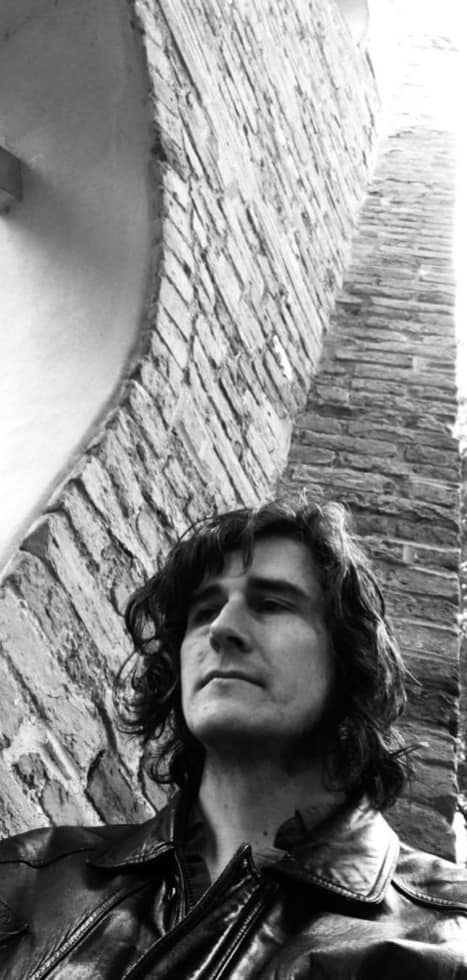
(•)> Nick Cave and Tom Waits loom large as reference points. What do you take from their approaches that feels most relevant to your own music?
Lyrically, they're both great storytellers. Different styles, of course: Cave excels at dramatic, fire & brimstone scenes, while Waits brings a very human side to his dusty, melancholic atmospheres. So I often find myself trying to find a mid-point between the two with my lyrics. Musically, Waits has a way of breathing so much life into all sorts of jerky, limping rhythms, which I really envy, and it's inspired me to think beyond the traditional band lineup, particularly with the unorthodox way he incorporates horns and percussion. Basically, he attacked a wooden cabinet with a big stick so that I could use stomping feet and clanking metal on 'Long Road Home'!
(•)> “Devil on my Shoulder” has a manic, almost feral energy. How important is tension and drama when you are arranging a song?
Very important: I'm not in the business of making "lounge music"! Unfortunately for people who like a groove or a steady backbeat, I've delved too deeply into Bebop, and a lot of Jazz-influenced rock groups like The Doors and King Crimson. Sure, you could create a solid, dependable vehicle for the lead guitarist, or you could create the musical equivalent of a tightrope walk, where all the musicians have to stay locked in with each other, or else the whole thing collapses. The latter might sound like barely-controlled chaos, but I find it much more thrilling.
(•)> You began this project after years as a sideman. What changed for you creatively when you stepped into leading your own vision?
Something definitely shifts when you're no longer writing for somebody else! On one hand, it was quite freeing; on the other, I had to try and narrow down what exactly I wanted this to be. Obviously, I'm still writing "for" someone, in the sense that I've got to consider my own limitations - my voice, for example, is going to suit gruff, gritty tones better than pristine choral vocals! Still, one thing I've noticed is that I've allowed myself to play some parts more simply. I think, when I was just in charge of one instrument, I felt more of a need to "make my mark" on that part...not to overdo it, but to try and bring something interesting or unusual to each song. Whereas now that I'm playing most of the parts, I feel more able to tell myself, "you know what? This doesn't need a particularly elaborate bassline."
(•)> Working with former bandmates gives the project a collective feel. How does collaboration influence songs that start out as very personal ideas?
A bit like the simpler parts I mentioned just now, it's been an important lesson for me to try to let things go! Not to say I'm a control freak, but by the time a song is ready to record, I have an idea in mind of what each part is going to sound like. And so, of course, if I'm playing all the parts myself, then that idea is what I play. But I should probably outsource some of these parts more often, because every time I've got someone else in, they've elevated the song in their own way. One of the best examples is 'Lilith': I asked Matt Steady if he'd add a violin part to it, and he came back to me with the most wonderful violin/viola duet, which completely transformed the song.

(•)> The phrase “a darker shade of the blues” suggests emotional depth as much as musical style. What does the blues mean to you in a modern context?
I've always said the Blues is a very "honest" form of music: you can be the most pitch-perfect singer, or the most technically adept guitarist, but people can tell straight away if you aren't feeling it. And I think that makes the Blues especially important now. The internet is being polluted more and more every day with AI-generated images and music that we're supposed to believe are "art." The companies that own these large language models would love for us to believe that their elaborate predictive algorithms can replace the human intent and feeling that makes art worth looking at, and music worth listening to. So playing the Blues can often feel like an act of defiance in the face of that - all the little nuances, even flaws, that make a performance sound human: they're going to become much more valuable as companies try to foist the gen-AI alternative on us.
(•)> For listeners discovering Ralph Beeby and the Elephant Collective for the first time, what do you hope “Devil on my Shoulder” tells them about who you are now?
It's a nice little window into the wilder side of what I'm doing, and a good taste of the fire and brimstone imagery still to come - that's going to be a big part of the next album, 'Salt and Sulphur', when I finally get there! And as with a lot of my previous releases, I hope it leads the way down a darker and more cinematic path for the Blues. A lot of the reviews it's received so far have talked about its immediacy, and used phrases like "statement of intent", so in any case, I don't think there's too much danger of it passing someone by as background music!

(•)> That's all, Folks! Check out Ralph Beeby & the Elephant Collective on the Pigeon Spins Playlist